Electronic Components Sales Market Analysis and Forecast (July 2026)
Table Of Contents
Prologue
1 July Macroeconomic Overview
1.1 Global Manufacturing Growth Slows Marginally with Widening Divergence
1.2 Stable Profitability & Accelerated Exports for China’s Electronic Information Manufacturing
1.3 Sustained Growth in Semiconductor Sales Highlights Resilient Demand
2 Chip Lead Time Trend – July
2.1 Overall Chip Lead Time Trends
2.2 Overview of Lead Times for Key Chip Suppliers
3 Order & Inventory Profile – July
4 Semiconductor Supply Chain – July
4.1 Upstream Semiconductor Manufacturers
(1)Silicon Wafer/Equipment
(2)Fabless/IDM
(3)Foundry
(4)OSAT
4.2 Distributor
4.3 System Integration
4.4 Terminal Application
(1)Consumer Electronics
(2)New Energy Vehicles
(3)Industrial Control
(4)Photovoltaic
(5)Energy Storage
(6)Data Center
(7)Communication
(8)Medical Equipment
5 Distribution and Sourcing Opportunities and Risks
5.1 Opportunities
5.2 Risk
6 Summarize
Disclaimer
Prologue
1 July Macroeconomic Overview
1.1 Global Manufacturing Growth Slows Marginally with Widening Divergence
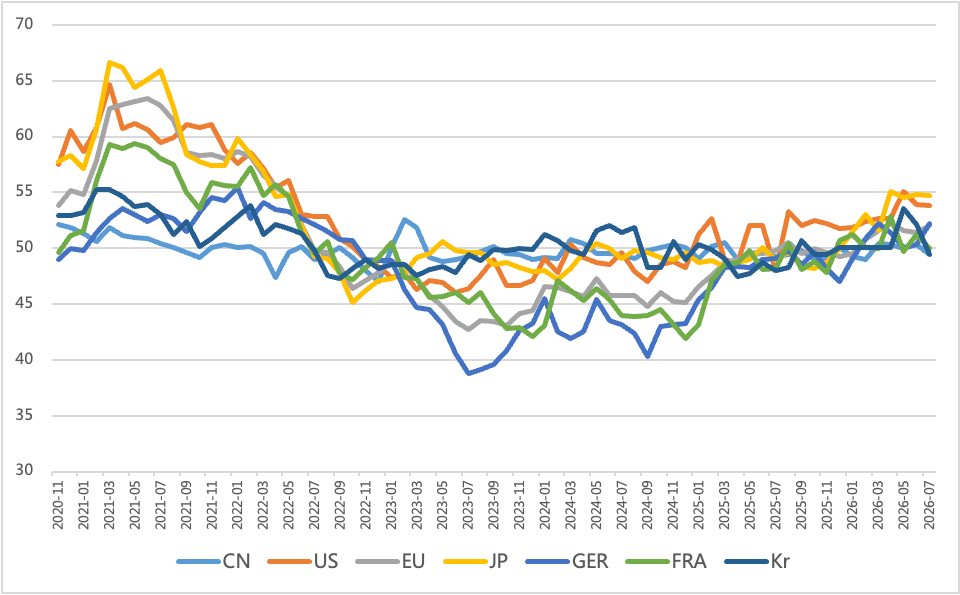
In July, the global manufacturing PMI edged down month-on-month. The sector remained in expansion territory, yet growth momentum weakened marginally, while economic sentiment across major economies diverged sharply. Total global industrial goods trade kept contracting, though structural bright spots emerged: products along the AI industrial chain served as the core driver of export growth for electromechanical goods. Notably, Japan’s manufacturing PMI reached 54.7, marking seven consecutive months of expansion, with new orders hitting their fastest growth in over five years.
Overall, global manufacturing stands at a complex juncture: expansion persists but momentum fades, regional gaps widen, and external risks accumulate.
Chart 1: Manufacturing PMI of Major Global Economies (July)
Source: NBSPRC
1.2 Latest Operation of Electronic Information Manufacturing Industry
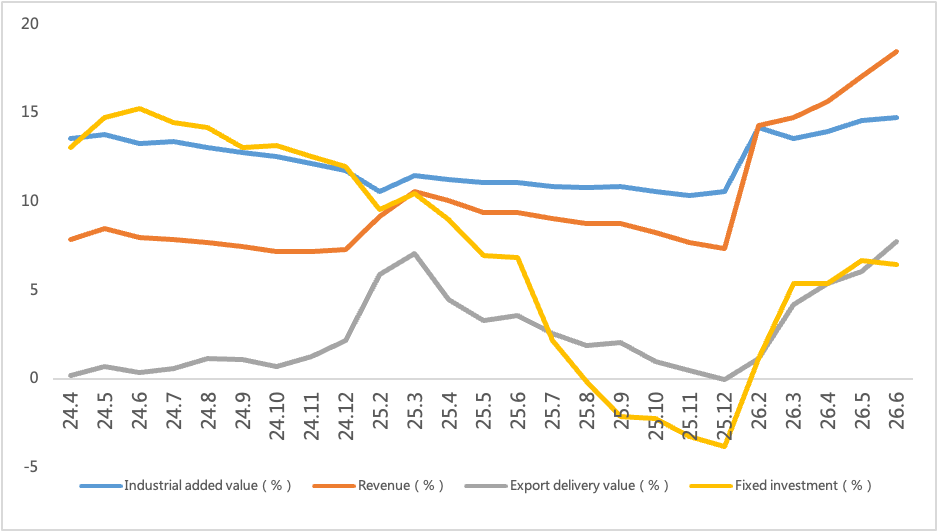
From January to June 2026, China’s electronic information manufacturing sector maintained faster production growth, robust export performance, rising profits and steady investment, presenting a sound overall development momentum.
Chart 2: Latest Operation of Electronic Information Manufacturing Industry
Source: MIIT
1.3 Sustained Growth in Semiconductor Sales Highlights Resilient Demand
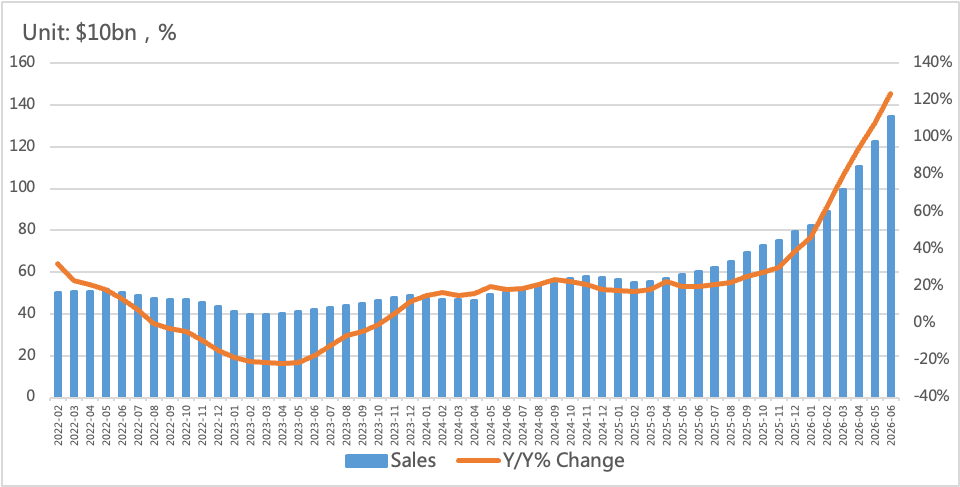
Per the latest data from the SIA, global semiconductor market revenue hit USD 134.45 billion in June, surging 123.6% year-on-year (YoY) and posting the 16th consecutive month of month-on-month (MoM) growth. Revenue for Q2 2026 totaled USD 403.30 billion, a 35.1% YoY increase.
By regional market: revenue in the Americas jumped 160.9% YoY, China’s market rose 112.8% YoY, while the Asia-Pacific region, Japan and Europe recorded YoY growth of 124.4%, 39.0% and 75.2% respectively. Strong sales in the Americas, Asia-Pacific and China continued to fuel overall market expansion.
Figure 3: Global Semiconductor Market Revenue & Growth Trend
Source: SIA,Chip Insights
In terms of IC output, global and Chinese integrated circuit production exceeded 134.8 billion units and 51.6 billion units respectively in June. China’s total output for the first half of the year reached 279.8 billion units, up 23.1% YoY, with daily output topping 1.5 billion units — an all-time high.
Figure 4: Global & China Integrated Circuit Output & Growth Trend
Source: WSTS,SIA,Chip Insights
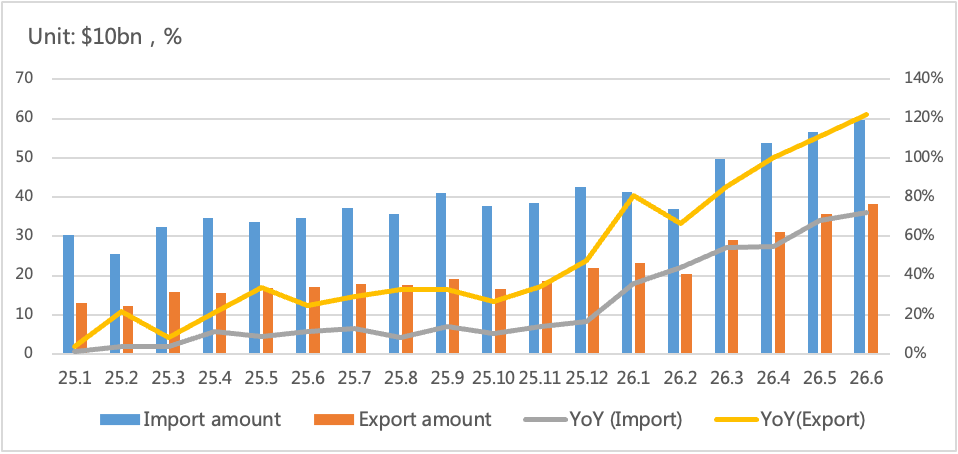
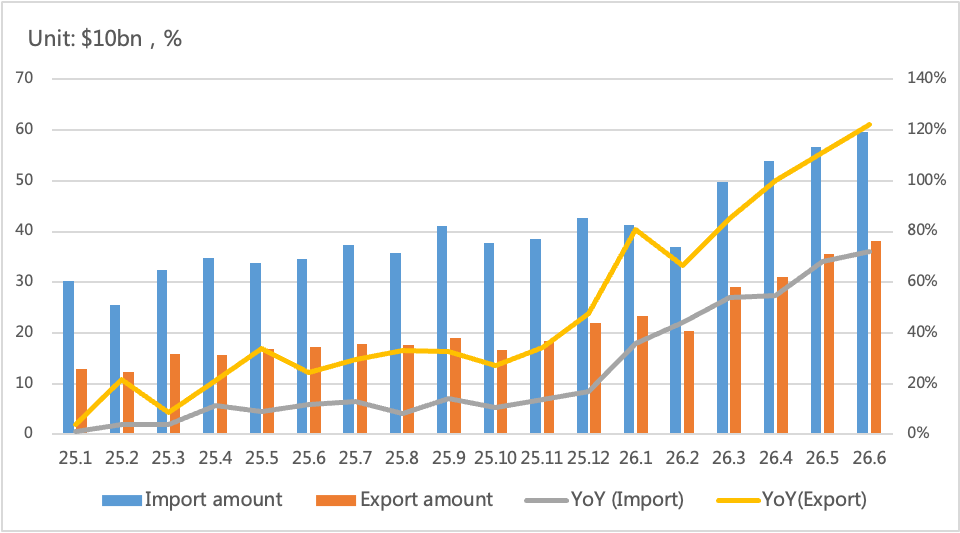
For import and export performance, China’s IC trade maintained robust growth in June, with export growth exceeding 100% YoY for three straight months.
Figure 5: China Integrated Circuit Import & Export Value and Growth Rate
Source: MIIT,SIA,Chip Insights
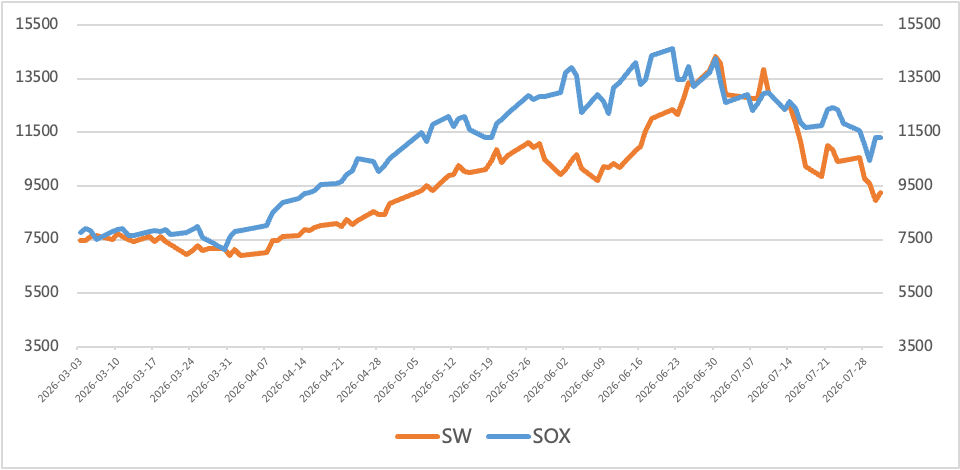
On the capital market front, amid concentrated profit-taking, weak market sentiment and headwinds from geopolitics, the Philadelphia Semiconductor Index (SOX) tumbled 15.3% in July, while the SW China Semiconductor Index plunged 34.1%.
Figure 6: Trend of SOX and SW Index in July
Source: Wind,Chip Insights
For more information, please refer to the attached report.
Electronic Components Sales Market Analysis and Forecast (July 2026)